Ficus
Ficus
Jump to navigation
Jump to search
| Fig trees | |
|---|---|
 | |
Sycamore fig, Ficus sycomorus | |
Scientific classification  | |
| Kingdom: | Plantae |
Clade: | Angiosperms |
Clade: | Eudicots |
Clade: | Rosids |
| Order: | Rosales |
| Family: | Moraceae |
| Tribe: | Ficeae Dumort. |
| Genus: | Ficus L. |
Species | |
About 800, see text | |
Ficus (/ˈfaɪkəs/[1] or /ˈfiːkəs/[2][3]) is a genus of about 850 species of woody trees, shrubs, vines, epiphytes and hemiepiphytes in the family Moraceae. Collectively known as fig trees or figs, they are native throughout the tropics with a few species extending into the semi-warm temperate zone. The common fig (F. carica) is a temperate species native to southwest Asia and the Mediterranean region (from Afghanistan to Portugal), which has been widely cultivated from ancient times for its fruit, also referred to as figs. The fruit of most other species are also edible though they are usually of only local economic importance or eaten as bushfood. However, they are extremely important food resources for wildlife. Figs are also of considerable cultural importance throughout the tropics, both as objects of worship and for their many practical uses.
Contents
1 Description
2 Ecology and uses
3 Fig fruit and reproduction system
4 Mutualism with the pollinating fig wasps
5 Systematics
6 Selected species
7 Cultivation
8 Cultural and spiritual significance
9 List of famous fig trees
10 Footnotes
11 References
12 External links
Description[edit]

Aerial roots that may eventually provide structural support

A Ficus carica (common fig)
Ficus is a pan-tropical genus of trees, shrubs and vines occupying a wide variety of ecological niches; most are evergreen, but some deciduous species are endemic to areas outside of the tropics and to higher elevations.[4] Fig species are characterized by their unique inflorescence and distinctive pollination syndrome, which utilizes wasp species belonging to the family Agaonidae for pollination.
The specific identification of many of the species can be difficult, but figs as a group are relatively easy to recognize. Many have aerial roots and a distinctive shape or habit, and their fruits distinguish them from other plants. The fig fruit is an enclosed inflorescence, sometimes referred to as a syconium, an urn-like structure lined on the inside with the fig's tiny flowers. The unique fig pollination system, involving tiny, highly specific wasps, known as fig wasps that enter via ostiole these sub-closed inflorescences to both pollinate and lay their own eggs, has been a constant source of inspiration and wonder to biologists.[5] Finally, there are three vegetative traits that together are unique to figs. All figs possess a white to yellowish latex, some in copious quantities; the twig has paired stipules or a circular stipule scar if the stipules have fallen off; and the lateral veins at the base of the leaf are steep, forming a tighter angle with the midrib than the other lateral veins, a feature referred to as "tri-veined".
There are no unambiguous older fossils of Ficus. However, current molecular clock estimates indicate that Ficus is a relatively ancient genus being at least 60 million years old,[5] and possibly as old as 80 million years. The main radiation of extant species, however, may have taken place more recently, between 20 and 40 million years ago.
Some better-known species that represent the diversity of the genus include the common fig, a small temperate deciduous tree whose fingered fig leaf is well known in art and iconography; the weeping fig (F. benjamina), a hemi-epiphyte with thin tough leaves on pendulous stalks adapted to its rain forest habitat; the rough-leaved sandpaper figs from Australia; and the creeping fig (F. pumila), a vine whose small, hard leaves form a dense carpet of foliage over rocks or garden walls.
Moreover, figs with different plant habits have undergone adaptive radiation in different biogeographic regions, leading to very high levels of alpha diversity. In the tropics, it is quite common to find that Ficus is the most species-rich plant genus in a particular forest. In Asia as many as 70 or more species can co-exist.[6]Ficus species richness declines with an increase in latitude in both hemispheres.[7][8]
Ecology and uses[edit]
Figs are keystone species in many tropical forest ecosystems. Their fruit are a key resource for some frugivores including fruit bats, and primates including: capuchin monkeys, langurs, gibbons and mangabeys. They are even more important for birds such as Asian barbets, pigeons, hornbills, fig-parrots and bulbuls, which may almost entirely subsist on figs when these are in plenty. Many Lepidoptera caterpillars feed on fig leaves, for example several Euploea species (crow butterflies), the plain tiger (Danaus chrysippus), the giant swallowtail (Papilio cresphontes), the brown awl (Badamia exclamationis), and Chrysodeixis eriosoma, Choreutidae and Copromorphidae moths. The citrus long-horned beetle (Anoplophora chinensis), for example, has larvae that feed on wood, including that of fig trees; it can become a pest in fig plantations. Similarly, the sweet potato whitefly (Bemisia tabaci) is frequently found as a pest on figs grown as potted plants and is spread through the export of these plants to other localities. For a list of other diseases common to fig trees, see List of foliage plant diseases (Moraceae).
The wood of fig trees is often soft and the latex precludes its use for many purposes. It was used to make mummy caskets in Ancient Egypt. Certain fig species (mainly F. cotinifolia, F. insipida and F. padifolia) are traditionally used in Mesoamerica to produce papel amate (Nahuatl: āmatl). Mutuba (F. natalensis) is used to produce barkcloth in Uganda. Pou (F. religiosa) leaves' shape inspired one of the standard kbach rachana, decorative elements in Cambodian architecture. Indian banyan (F. bengalensis) and the Indian rubber plant, as well as other species, have use in herbalism.
Figs have figured prominently in some human cultures. There is evidence that figs, specifically the common fig (F. carica) and sycamore fig (Ficus sycomorus), were among the first – if not the very first – plant species that were deliberately bred for agriculture in the Middle East, starting more than 11,000 years ago. Nine subfossil F. carica figs dated to about 9400–9200 BCE were found in the early Neolithic village Gilgal I (in the Jordan Valley, 13 km north of Jericho). These were a parthenogenetic type and thus apparently an early cultivar. This find predates the first known cultivation of grain in the Middle East by many hundreds of years.[9]
The 1889 book 'The Useful Native Plants of Australia’ records that Ficus aspera had the common names "Rough-leaved Fig", "Purple Fig" and "White Fig" and that Indigenous Australians of the Rockhampton region referred to them as "Noomaie" and in Cleveland Bay (Queensland) "Balemo". It also states that the fruit which is black can be eaten.[10]
Fig fruit and reproduction system[edit]
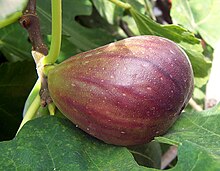
A common fig's syconium (fruit)
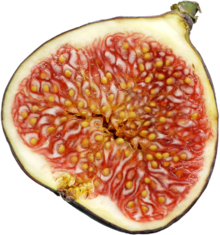
Cut through of a ripe common fig
Many fig species are grown for their fruits, though only Ficus carica is cultivated to any extent for this purpose. The fig fruits, important as both food and traditional medicine, contain laxative substances, flavonoids, sugars, vitamins A and C, acids and enzymes. However, figs are skin allergens, and the latex is a serious eye irritant.
A fig "fruit" is a type of multiple fruit known as a syconium, derived from an arrangement of many small flowers on an inverted, nearly closed receptacle. The many small flowers are unseen unless the fig is cut open. In Chinese the fig is called wú huā guǒ (simplified Chinese: 无花果; traditional Chinese: 無花果), "fruit without flower".[11] In Bengali, where the common fig is called dumur, it is referenced in a proverb: tumi jeno dumurer phool hoe gele ("You have become [invisible like] the dumur flower").
The syconium often has a bulbous shape with a small opening (the ostiole) at the outward end that allows access to pollinators. The flowers are pollinated by very small wasps that crawl through the opening in search of a suitable place to lay eggs. Without this pollinator service fig trees could not reproduce by seed. In turn, the flowers provide a safe haven and nourishment for the next generation of wasps. This accounts for the frequent presence of wasp larvae in the fruit, and has led to a coevolutionary relationship. Technically, a fig fruit proper would be only one of the many tiny matured, seed-bearing gynoecia found inside one fig – if you cut open a fresh fig, individual fruit will appear as fleshy "threads", each bearing a single seed inside. The genus Dorstenia, also in the fig family (Moraceae), exhibits similar tiny flowers arranged on a receptacle but in this case the receptacle is a more or less flat, open surface.
Fig plants can be monoecious (hermaphrodite) or gynodioecious (hermaphrodite and female).[12] Nearly half of fig species are gynodioecious, and therefore have some plants with inflorescences (syconium) with long styled pistillate flowers, and other plants with staminate flowers mixed with short styled pistillate flowers.[13] The long flowers styles tend to prevent wasps from laying their eggs within the ovules, while the short styled flowers are accessible for egg laying.[14]
All the native fig trees of the American continent are hermaphrodites, as well as species like Indian banyan (F. benghalensis), weeping fig (F. benjamina), Indian rubber plant (F. elastica), fiddle-leaved fig (F. lyrata), Moreton Bay fig (F. macrophylla), Chinese banyan (F. microcarpa), sacred fig (F. religiosa) and sycamore fig (F. sycomorus).[15]
On the other hand, the common fig (Ficus carica) is a gynodioecious plant, as well as lofty fig or clown fig (F. aspera), Roxburgh fig (F. auriculata), mistletoe fig (F. deltoidea), F. pseudopalma, creeping fig (F. pumila) and related species.
The hermaphrodite common figs are called "inedible figs" or "caprifigs"; in traditional culture in the Mediterranean region they were considered food for goats (Capra aegagrus). In the female fig trees, the male flower parts fail to develop; they produce the "'edible figs". Fig wasps grow in common fig caprifigs but not in the female syconiums because the female flower is too long for the wasp to successfully lay her eggs in them. Nonetheless, the wasp pollinates the flower with pollen from the caprifig it grew up in. When the wasp dies, it is broken down by enzymes (Ficain) inside the fig. Fig wasps are not known to transmit any diseases harmful to humans.
When a caprifig ripens, another caprifig must be ready to be pollinated. In temperate climes, wasps hibernate in figs, and there are distinct crops. Caprifigs have three crops per year; common figs have two.[16] The first crop (breba) is larger and more juicy, and is usually eaten fresh.[16] In cold climates the breba crop is often destroyed by spring frosts.[17] Some parthenocarpic cultivars of common figs do not require pollination at all, and will produce a crop of figs (albeit sterile) in the absence of caprifigs or fig wasps.
Depending on the species, each fruit can contain hundreds or even thousand of seeds.[18] Figs can be propagated by seeds, cuttings, air-layering or grafting. However, as with any plant, figs grown from seed are not necessarily genetically identical to the parent and are only propagated this way for breeding purposes.
Mutualism with the pollinating fig wasps[edit]

Ficus exasperata, fruits
Each species of fig is pollinated by one or a few specialised wasp species, and therefore plantings of fig species outside of their native range results in effectively sterile individuals. For example, in Hawaii, some 60 species of figs have been introduced, but only four of the wasps that fertilize them have been introduced, so only four species of figs produce viable seeds there and can become invasive species. This is an example of mutualism, in which each organism (fig plant and fig wasp) benefit each other, in this case reproductively.
The intimate association between fig species and their wasp pollinators, along with the high incidence of a one-to-one plant-pollinator ratio have long led scientists to believe that figs and wasps are a clear example of coevolution. Morphological and reproductive behavior evidence, such as the correspondence between fig and wasp larvae maturation rates, have been cited as support for this hypothesis for many years.[19] Additionally, recent genetic and molecular dating analyses have shown a very close correspondence in the character evolution and speciation phylogenies of these two clades.[5]
According to meta-analysis of molecular data for 119 fig species 35% (41) have multiple pollinator wasp species. The real proportion is higher because not all wasp species were detected.[20] On the other hand, species of wasps pollinate multiple host fig species.[21] Molecular techniques, like microsatellite markers and mitochondrial sequence analysis, allowed a discovery of multiple genetically distinct, cryptic wasp species. Not all these cryptic species are sister taxa and thus must have experienced a host fig shift at some point.[22] These cryptic species lacked evidence of genetic introgression or backcrosses indicating limited fitness for hybrids and effective reproductive isolation and speciation.[22]
The existence of cryptic species suggests that neither the number of symbionts nor their evolutionary relationships are necessarily fixed ecologically. While the morphological characteristics that facilitate the fig-wasp mutualisms are likely to be shared more fully in closer relatives, the absence of unique pairings would make it impossible to do a one-to-one tree comparison and difficult to determine cospeciation.
Systematics[edit]
With 800 species, Ficus is by far the largest genus in the Moraceae, and is one of the largest genera of flowering plants currently described.[23] The species currently classified within Ficus were originally split into several genera in the mid-1800s, providing the basis for a subgeneric classification when reunited into one genus in 1867. This classification put functionally dioecious species into four subgenera based on floral characters.[24] In 1965, E. J. H. Corner reorganized the genus on the basis of breeding system, uniting these four dioecious subgenera into a single dioecious subgenus Ficus. Monoecious figs were classified within the subgenera Urostigma, Pharmacosycea and Sycomorus.[25]
This traditional classification has been called into question by recent phylogenetic studies employing genetic methods to investigate the relationships between representative members of the various sections of each subgenus.[5][24][26][27][28] Of Corner's original subgeneric divisions of the genus, only Sycomorus is supported as monophyletic in the majority of phylogenetic studies.[5][24][27] Notably, there is no clear split between dioecious and monoecious lineages.[5][24][26][27][28] One of the two sections of Pharmacosycea, a monoecious group, form a monophyletic clade basal to the rest of the genus, which includes the other section of Pharmacosycea, the rest of the monoecious species, and all of the dioecious species.[28] These remaining species are divided into two main monophyletic lineages (though the statistical support for these lineages isn't as strong as for the monophyly of the more derived clades within them). One consists of all sections of Urostigma except for section Urostigma s. s.. The other includes section Urostigma s. s., subgenus Sycomorus, and the species of subgenus Ficus, though the relationships of the sections of these groups to one another are not well resolved.[5][28]
Selected species[edit]
Subgenus Ficus
Ficus amplissima Sm. – bat fig
Ficus benjamina L., 1767 – weeping fig
Ficus carica L. – common fig
Ficus daimingshanensis Chang
Ficus deltoidea Jack – mistletoe fig
Ficus erecta Thunb. – Japanese fig
Ficus grossularioides Burman f. – white-leaved fig
Ficus hirta Vahl
Ficus neriifolia Sm.
Ficus palmata Forssk.
Ficus pandurata Hance
Ficus ischnopoda Miq.
Ficus vaccinioides King
Ficus variolosa Lindl. ex Benth.
Subgenus Pharmacosycea
Ficus adhatodifolia Schott
Ficus apollinaris Dugand
Ficus carchiana Berg
Ficus crassiuscula Standl.
Ficus ecuadorensis Berg
Ficus dicranostyla Mildbr.
Ficus gigantosyce Dugand
Ficus guajavoides Lundell
Ficus illiberalis Corner
Ficus insipida Willd.
Ficus lacunata Kvitvik
Ficus macbridei Standl.
Ficus maxima Mill.
Ficus mutabilis Bureau
Ficus mutisii Dugand
Ficus nervosa Heyne ex Roth
Ficus obtusiuscula Miq.
Ficus piresiana Vázquez Avila & Berg
Ficus pulchella Schott
Ficus rieberiana Berg
Ficus tonduzii Standl.
Ficus yoponensis Desv.
Subgenus Sycidium
Ficus andamanica Corner
Ficus aspera G.Forst.
Ficus bojeri Baker
Ficus capreifolia Delile
Ficus coronata Spin – creek sandpaper fig
Ficus fraseri Miq. – shiny sandpaper fig
Ficus fulvopilosa Summerh.
Ficus godeffroyi Warb.
Ficus greenwoodii Summerh.
Ficus heterophylla L.f.
Ficus lateriflora Vahl
Ficus masonii Baker
Ficus montana Burm.f. – oakleaf fig
Ficus opposita Miq. – sweet sandpaper fig
Ficus scabra G.Forst.
Ficus tinctoria G.Forst. – dye fig
Ficus ulmifolia Lam.
Ficus virgata Blume
Ficus wassa Roxb.
Subgenus Sycomorus
Ficus auriculata Lour. – Roxburgh fig
Ficus benguetensis Merr.
Ficus congesta Roxb.
Ficus dammaropsis Diels – highland breadfruit, kapiak
Ficus fistulosa Blume
Ficus hispida L.
Ficus mauritiana Lam.
Ficus minahassae Teijsmann & de Vriese
Ficus mollior Bentham
Ficus nana Corner
Ficus nota Merr. – tibig
Ficus pseudopalma Blanco
Ficus racemosa L. – cluster fig
Ficus septica Burm.f. – hauli tree
Ficus sycomorus L. – sycamore fig
Ficus variegata Blume
Subgenus Synoecia[29]
Ficus barba-jovis Corner[30]
Ficus hederacea Roxb.[30]
Ficus laevis Blume[31]
Ficus pantoniana King[32] – climbing fig
Ficus pumila L.[31] – creeping fig
Ficus pumila var. awkeotsang (Makino) Corner
Ficus punctata Thunb.[33]
Ficus sarmentosa Buch.-Ham. ex Sm.
Ficus villosa Blume[34]
Subgenus Urostigma
Ficus abutilifolia Miq.
Ficus albert-smithii Standl.
Ficus altissima Blume
Ficus amazonica Miq.
Ficus americana Aubl.
Ficus aripuanensis Berg & Kooy
Ficus arpazusa Carauta and Diaz – Brazil[35]
Ficus aurea Nutt. – Florida strangler fig
Ficus beddomei King – thavital
Ficus benghalensis L. – Indian banyan
Ficus benjamina L. – weeping fig
Ficus binnendijkii Miq.
Ficus bizanae Hutch. & Burtt-Davy
Ficus blepharophylla Vázquez Avila
Ficus broadwayi Urb.
Ficus bubu Warb.
Ficus burtt-davyi Hutch.
Ficus calyptroceras Miq.
Ficus castellviana Dugand
Ficus catappifolia Kunth & Bouché
Ficus caulocarpa Miq.
Ficus citrifolia Mill. – short-leaved fig
Ficus cordata Thunb.
Ficus costaricana Miq.
Ficus cotinifolia Kunth
Ficus crassipes F.M.Bailey – round-leaved banana fig
Ficus craterostoma Mildbr. & Burret
Ficus cyathistipula Warb.
Ficus cyclophylla (Miq.) Miq.
Ficus dendrocida Kunth
Ficus destruens F.White
Ficus drupacea Thunb.
Ficus elastica Hornem. – rubber plant
Ficus elasticoides De Wild.
Ficus enormis Miq.
Ficus exasperata Vahl.
Ficus faulkneriana Berg
Ficus fergusonii (King) T.B.Worth. ex Corner
Ficus fischeri Mildbr. & Burret
Ficus glaberrima Blume
Ficus glumosa Delile
Ficus gomelleira Kunth & Bouché
Ficus greiffiana Dugand
Ficus guaranitica Chodat – Brazil, Paraguay and Argentina[36]
Ficus guianensis Desv.
Ficus hirsuta Schott
Ficus ilicina Miq.
Ficus kerkhovenii Valeton[37] – Johore fig
Ficus luschnathiana Miq.
Ficus ingens Miq.
Ficus krukovii Standl.
Ficus lacor Buch.-Ham.
Ficus lapathifolia Miq.
Ficus lauretana Vázquez Avila
Ficus lutea Vahl
Ficus lyrata Warb. – fiddle-leaved fig
Ficus maclellandii King – Alii fig
Ficus macrophylla Desf. ex Pers. – Moreton Bay fig
Ficus malacocarpa Standl.
Ficus mariae Berg, Emygdio & Carauta
Ficus mathewsii Miq.
Ficus matiziana Dugand
Ficus mexiae Standl.
Ficus microcarpa L. – Chinese banyan
Ficus muelleriana Berg
Ficus natalensis Hochst. – Natal fig
Ficus obliqua G.Forst. – small-leaved fig
Ficus obtusifolia Kunth
Ficus pakkensis Standl.
Ficus pallida Vahl
Ficus panurensis Standl.
Ficus pertusa L.f.
Ficus petiolaris Kunth
Ficus platypoda Cunn. – desert fig
Ficus pleurocarpa DC. – banana fig
Ficus polita Vahl
Ficus prolixa G.Forst.
Ficus religiosa L. – sacred fig
Ficus roraimensis Berg
Ficus rubiginosa Desf. – Port Jackson fig
Ficus rumphii Blume
Ficus salicifolia Vahl – willow-leaved fig
Ficus sansibarica Warb.
Ficus saussureana DC.
Ficus schippii Standl.
Ficus schultesii Dugand
Ficus schumacheri Griseb.
Ficus sphenophylla Standl.
Ficus stuhlmannii Warb.
Ficus subpisocarpa Gagnep.
Ficus subpuberula Corner
Ficus superba Miq.
Ficus sycomorus Miq.
Ficus superba var. henneana (Miq.) Corner
Ficus tettensis Hutch.
Ficus thonningii Blume
Ficus tremula Warb.
Ficus trichopoda Baker
Ficus trigona L.f.
Ficus trigonata L.
Ficus triradiata Corner – red-stipule fig
Ficus umbellata Vahl
Ficus ursina Standl.
Ficus velutina Willd.
Ficus verruculosa Warb.
Ficus virens Aiton – white fig
Ficus virens var. sublanceolata (Miq.) Corner – sour fig
Ficus watkinsiana F.M.Bailey – Watkins's fig
Unknown subgenus
- Ficus bibracteata
- Ficus cristobalensis
- Ficus hebetifolia
Ficus tsjahela Burm.f.
Cultivation[edit]
Numerous species of fig are found in cultivation in domestic and office environments, including:[38]
F. binnendijkii, narrow-leaf fig – hardy to 5 °C (41 °F)
F. carica, common fig – hardy to −10 °C (14 °F). Shrub or small tree which can be grown outdoors in mild temperate regions, producing substantial harvests of fruit. Many cultivars are available.
F. benjamina, weeping fig, ficus – hardy to 5 °C (41 °F). Widely used as an indoor plant for the home or the office. It benefits from the dry, warm atmosphere of centrally-heated interiors, and can grow to substantial heights in a favoured position. Several variegated cultivars are available.
F. elastica, rubber plant – hardy to 10 °C (50 °F): widely cultivated as a houseplant; several cultivars with variegated leaves
F. lyrata, fiddle-leaf fig – hardy to 10 °C (50 °F)
F. microcarpa, Indian laurel – hardy to 10 °C (50 °F)
F. pumila, creeping fig – hardy to 1 °C (34 °F)
F. rubiginosa, Port Jackson fig – hardy to 10 °C (50 °F)
Cultural and spiritual significance[edit]
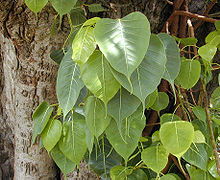
Leaves of the sacred fig (Ficus religiosa)

Fig tree roots overgrowing a sandstone Buddha statue, near Wat Maha That in Ayutthaya province, Thailand
Fig trees have profoundly influenced culture through several religious traditions. Among the more famous species are the sacred fig tree (Pipal, bodhi, bo, or po, Ficus religiosa) and the banyan fig (Ficus benghalensis). The oldest living plant of known planting date is a Ficus religiosa tree known as the Sri Maha Bodhi planted in the temple at Anuradhapura, Sri Lanka by King Tissa in 288 BCE. The common fig is one of two significant trees in Islam, and there is a sura in Quran named "The Fig" or At-Tin (سوره تین). In Asia, figs are important in Buddhism and Hinduism. In Jainism, the consumption of any fruit belonging to this genus is prohibited.[39] The Buddha is traditionally held to have found bodhi (enlightenment) while meditating under a sacred fig. The same species was Ashvattha, the "world tree" of Hinduism. The Plaksa Pra-sravana was said to be a fig tree between the roots of which the Sarasvati River sprang forth; it is usually held to be a sacred fig but more probably is Ficus virens. According to the Kikuyu people, sacrifices to Ngai were performed under a sycomore tree (Mũkũyũ) and if one was not available, a fig tree (Mũgumo) would be used. The common fig tree is cited in the Bible, where in Genesis 3:7, Adam and Eve cover their nakedness with fig leaves. The fig fruit is also one of the traditional crops of Israel, and is included in the list of food found in the Promised Land, according to the Torah (Deut. 8). Jesus cursed a fig tree for bearing no fruit (Mark 11:12–14). The fig tree was sacred in ancient Cyprus where it was a symbol of fertility.
List of famous fig trees[edit]
Ashvattha – the world tree of Hinduism, held to be a supernatural F. religiosa
Bodhi tree – a F. religiosa
Charybdis Fig Tree of Homer's Odyssey, presumably a F. carica
Curtain Fig Tree – a F. virens
Ficus Ruminalis – a F. carica
Plaksa – another supernatural fig in Hinduism; usually identified as F. religiosa but is probably F. virens
Santa Barbara's Moreton Bay Fig Tree – a F. macrophylla
Sri Maha Bodhi – another F. religiosa, planted in 288 BCE, the oldest human-planted tree on record
The Great Banyan – a F. benghalensis, a clonal colony and once the largest organism known
Vidurashwatha – "Vidura's Sacred Fig Tree", a village in India named after a famous F. religiosa that until recently stood there
Wonderboom – the largest fig tree in Pretoria, South Africa
Footnotes[edit]
^ "ficus". Merriam-Webster – via merriam-webster.com..mw-parser-output cite.citation{font-style:inherit}.mw-parser-output .citation q{quotes:"""""""'""'"}.mw-parser-output .citation .cs1-lock-free a{background:url("//upload.wikimedia.org/wikipedia/commons/thumb/6/65/Lock-green.svg/9px-Lock-green.svg.png")no-repeat;background-position:right .1em center}.mw-parser-output .citation .cs1-lock-limited a,.mw-parser-output .citation .cs1-lock-registration a{background:url("//upload.wikimedia.org/wikipedia/commons/thumb/d/d6/Lock-gray-alt-2.svg/9px-Lock-gray-alt-2.svg.png")no-repeat;background-position:right .1em center}.mw-parser-output .citation .cs1-lock-subscription a{background:url("//upload.wikimedia.org/wikipedia/commons/thumb/a/aa/Lock-red-alt-2.svg/9px-Lock-red-alt-2.svg.png")no-repeat;background-position:right .1em center}.mw-parser-output .cs1-subscription,.mw-parser-output .cs1-registration{color:#555}.mw-parser-output .cs1-subscription span,.mw-parser-output .cs1-registration span{border-bottom:1px dotted;cursor:help}.mw-parser-output .cs1-ws-icon a{background:url("//upload.wikimedia.org/wikipedia/commons/thumb/4/4c/Wikisource-logo.svg/12px-Wikisource-logo.svg.png")no-repeat;background-position:right .1em center}.mw-parser-output code.cs1-code{color:inherit;background:inherit;border:inherit;padding:inherit}.mw-parser-output .cs1-hidden-error{display:none;font-size:100%}.mw-parser-output .cs1-visible-error{font-size:100%}.mw-parser-output .cs1-maint{display:none;color:#33aa33;margin-left:0.3em}.mw-parser-output .cs1-subscription,.mw-parser-output .cs1-registration,.mw-parser-output .cs1-format{font-size:95%}.mw-parser-output .cs1-kern-left,.mw-parser-output .cs1-kern-wl-left{padding-left:0.2em}.mw-parser-output .cs1-kern-right,.mw-parser-output .cs1-kern-wl-right{padding-right:0.2em}
^ Sunset Western Garden Book. 1995. pp. 606–607. ISBN 978-0-37603-851-7.
^ "Definition of 'ficus'". Collins English Dictionary – via collinsdictionary.com.
^ Halevy, Abraham H. (1989). Handbook of Flowering Volume 6 of CRC Handbook of Flowering. CRC Press. p. 331. ISBN 978-0-8493-3916-5. Retrieved 2009-08-25.
^ abcdefg Rønsted et al. (2005).
^ Harrison (2005).
^ van Noort & van Harten (2006).
^ Berg & Hijmann (1989).
^ Kislev, Hartmann & Bar-Yosef (2006).
^ J. H. Maiden (1889). The useful native plants of Australia : Including Tasmania. Sydney: Turner and Henderson.
^ Denisowski (2007).
^ Armstrong, Wayne P; Disparti, Steven (4 April 1998). "A Key to Subgroups of Dioecious* (Gynodioecious) Figs Based On Fig Wasp/Male Syconium Pollination Patterns". Wayne's Word. Archived from the original on 2012-02-02. Retrieved 2012-01-05.
^ Friis, Ib; Balslev, Henrik (2005). Plant diversity and complexity patterns: local, regional, and global dimensions:. Kgl. Danske Videnskabernes Selskab. p. 472. ISBN 978-87-7304-304-2.
^ Valdeyron, Georges; Lloyd, David G. (June 1979). "Sex Differences and Flowering Phenology in the Common Fig, Ficus carica L.". Evolution. Society for the Study of Evolution. 33 (2): 673–685. doi:10.2307/2407790. JSTOR 2407790.
^ Berg & Corner (2005).
^ ab Sinha, K.K. (2003). "Figs". Encyclopedia of Food Sciences and Nutrition (2nd ed.). Elsevier Science Ltd. ISBN 978-0-12-227055-0. Retrieved 2018-04-22 – via ScienceDirect: Fig Wasp.
^ California Rare Fruit Growers, Inc. (1996): Fig. Retrieved November 1, 2008.
^ "The Weird Sex Life of the Fig" (PDF). Ray's Figs. Retrieved 2012-01-05.
^ Machado, C. A.; Jousselin, E.; Kjellberg, F.; Compton, S. G.; Herre, E. A. (7 April 2001). "Phylogenetic relationships, historical biogeography and character evolution of fig-pollinating wasps". Proceedings of the Royal Society B: Biological Sciences. The Royal Society. 268 (1468): 685–694. doi:10.1098/rspb.2000.1418.
^ Yang, Li-Yuan; Machado, Carlos A.; Dang, Xiao-Dong; Peng, Yan-Qiong; Yang, Da-Rong; Zhang, Da-Yong; Liao, Wan-Jin (February 2015). "The incidence and pattern of copollinator diversification in dioecious and monoecious figs". Evolution. 69 (2): 294–304. doi:10.1111/evo.12584.
^ Machado, C. A.; Robbins, N.; Gilbert, M. T. P.; Herre, E. A. (3 May 2005). "Critical review of host specificity and its coevolutionary implications in the fig/fig-wasp mutualism". Proceedings of the National Academy of Sciences. 102 (Supplement 1): 6558–6565. doi:10.1073/pnas.0501840102.
^ ab Molbo, D.; Machado, C.A.; Sevenster, J.G.; Keller, L.; Herre, E.A. (24 April 2003). "Cryptic species of fig-pollinating wasps: Implications for the evolution of the fig-wasp mutualism, sex allocation, and precision of adaptation". Proceedings of the National Academy of Sciences. 100 (10): 5867–5872. doi:10.1073/pnas.0930903100. PMC 156293.
^ Judd, W.S.; Campbell, C.S.; Kellogg, E.A.; Stevens, P.F.; Donoghue, M.J. (2008). Plant Systematics: A phylogenetic approach (3rd ed.). Sunderland (Massachusetts): Sinauer Associates. ISBN 978-0-87893-407-2.
^ abcd Weiblen, G.D. (2000). "Phylogenetic relationships of functionally dioecious Ficus (Moraceae) based on ribosomal DNA sequences and morphology" (PDF). American Journal of Botany. 87 (9): 1342–1357. Retrieved 2018-04-22.
^ Corner, E.J.H. (1965). "Check-list of Ficus in Asia and Australasia with keys to identification". The Gardens' Bulletin Singapore. 21 (1): 1–186. Retrieved 5 Feb 2014 – via biodiversitylibrary.org.
^ ab Herre, E.; Machado, C.A.; Bermingham, E.; Nason, J.D.; Windsor, D.M.; McCafferty, S.; Van Houten, W.; Bachmann, K. (1996). "Molecular phylogenies of figs and their pollinator wasps". Journal of Biogeography. 23 (4): 521–530. doi:10.1111/j.1365-2699.1996.tb00014.x.
^ abc Jousselin, E.; Rasplus, J.-Y.; Kjellberg, F. (2003). "Convergence and coevolution in a mutualism: evidence from a molecular phylogeny of Ficus". Evolution; international journal of organic evolution. 57 (6): 1255–1269. doi:10.1554/02-445.
^ abcd Rønsted et al. (2008).
^ Berg (2003).
^ ab Berg (2003), p. 552.
^ ab Berg (2003), p. 553.
^ Berg (2003), p. 554.
^ Berg (2003), pp. 565.
^ Berg (2003), pp. 553–554.
^ Carauta & Diaz (2002), pp. 38–39.
^ Carauta & Diaz (2002), pp. 64–66.
^ Joseph Lai; Angie Ng; Chuah Ai Lin; Marilyn Cheng (12 September 2002). "Significant Trees and Shrubs in Changi". Retrieved 2012-01-05.
^ Brickell, Christopher, ed. (2008). The Royal Horticultural Society A-Z Encyclopedia of Garden Plants. United Kingdom: Dorling Kindersley. p. 448. ISBN 9781405332965.
^ Tukol, T.K. (1980). Compendium of Jainism. Prasaranga: Karnatak University. p. 206.
References[edit]
.mw-parser-output .refbegin{font-size:90%;margin-bottom:0.5em}.mw-parser-output .refbegin-hanging-indents>ul{list-style-type:none;margin-left:0}.mw-parser-output .refbegin-hanging-indents>ul>li,.mw-parser-output .refbegin-hanging-indents>dl>dd{margin-left:0;padding-left:3.2em;text-indent:-3.2em;list-style:none}.mw-parser-output .refbegin-100{font-size:100%}
Berg, C.C. (28 November 2003). "Flora Malesiana Precursor for the Treatment of Moraceae 4: Ficus subgenus Synoecia". Blumea. 48: 551–571. doi:10.3767/000651903X489546.
Berg, C.C.; Hijmann, M.E.E. (1989). "Chapter 11: Ficus". In R.M. Polhill. Flora of Tropical East Africa. pp. 43–86.
Berg, C.C.; Corner, E.J.H. (2005). "Moraceae". Flora Malesiana. Ser. I. vol. 17, part 2.
Carauta, Pedro; Diaz, Ernani (2002). Figueiras no Brasil. Rio de Janeiro: Editora UFRJ. ISBN 85-7108-250-2.
Condit, Ira J. (1969): Ficus: the exotic species. University of California, Division of Agricultural Sciences.
Denisowski, Paul (2007). "Fig". Chinese–English Dictionary. Retrieved November 1, 2008.
Harrison, Rhett D (2005). "Figs and the diversity of tropical rain forests" (PDF). BioScience. 55 (12): 1053–1064. doi:10.1641/0006-3568(2005)055[1053:FATDOT]2.0.CO;2.
Kislev, Mordechai E.; Hartmann, Anat; Bar-Yosef, Ofer (2006). "Early Domesticated Fig in the Jordan Valley". Science. 312 (5778): 1372–1374. doi:10.1126/science.1125910. PMID 16741119.
Supporting Online Material
Kislev, Mordechai E.; Hartmann, Anat; Bar-Yosef, Ofer (2006). "Response to Comment on "Early Domesticated Fig in the Jordan Valley"". Science. 314 (5806): 1683b. doi:10.1126/science.1133748.
Lev-Yadun, Simcha; Ne'eman, Gidi; Abbo, Shahal; Flaishman, Moshe A (2006). "Comment on "Early Domesticated Fig in the Jordan Valley"". Science. 314 (5806): 1683a. doi:10.1126/science.1132636. PMID 17170278.
Lewington, Anna; Parker, Edward (1999). Ancient trees: Trees that live for 1000 years. London: Collins & Brown. ISBN 18-5585-704-9.
Rønsted, Nina; Weiblen, George D.; Cook, James M.; Salamin, Nicholas; Machado, Carlos A.; Savoainen, Vincent (2005). "60 million years of co-divergence in the fig-wasp symbiosis". Proceedings of the Royal Society B: Biological Sciences. 272 (1581): 2593–2599. doi:10.1098/rspb.2005.3249. PMC 1559977.
Rønsted, N; Weiblen, G.D.; Clement, W.L.; Zerega, N.J.C.; Savolainen, V. (2008). "Reconstructing the phylogeny of figs (Ficus, Moraceae) to reveal the history of the fig pollination mutualism" (PDF). Symbiosis. 45. ISSN 0334-5114.
Shanahan, M.; Compton, S. G.; So, Samson; Corlett, Richard (2001). "Fig-eating by vertebrate frugivores: a global review". Biological Reviews. 76 (4): 529–572. doi:10.1017/S1464793101005760. PMID 11762492.
Electronic appendices
van Noort, Simon; van Harten, Antonius (2006). "The species richness of fig wasps (Hymenoptera: Chalcidoidea: Agaonidae, Pteromalidae) in Yemen". Fauna of Arabia. 22: 449–472. Retrieved 2013-01-01.
External links[edit]
 | Wikimedia Commons has media related to Ficus. |
Figweb Major reference site for the genus Ficus
Video: Interaction of figs and fig wasps Multi-award-winning documentary- Fruits of Warm Climates: Fig
- BBC: Fig fossil clue to early farming
Video
- How the fig tree strangles other plants for survival in the rainforest
Categories:
- Ficus
- Trees of Europe
- Taxa named by Carl Linnaeus
- Rosales genera
- Moraceae genera


(window.RLQ=window.RLQ||).push(function(){mw.config.set({"wgPageParseReport":{"limitreport":{"cputime":"2.144","walltime":"2.495","ppvisitednodes":{"value":6772,"limit":1000000},"ppgeneratednodes":{"value":0,"limit":1500000},"postexpandincludesize":{"value":97404,"limit":2097152},"templateargumentsize":{"value":2899,"limit":2097152},"expansiondepth":{"value":11,"limit":40},"expensivefunctioncount":{"value":27,"limit":500},"unstrip-depth":{"value":1,"limit":20},"unstrip-size":{"value":106241,"limit":5000000},"entityaccesscount":{"value":26,"limit":400},"timingprofile":["100.00% 1991.620 1 -total"," 25.31% 504.167 1 Template:Reflist"," 18.84% 375.306 18 Template:Cite_journal"," 18.29% 364.253 1 Template:Automatic_taxobox"," 17.63% 351.100 1 Template:Taxobox/core"," 14.54% 289.620 1 Template:Taxonbar"," 7.80% 155.443 5 Template:Cite_web"," 6.87% 136.917 13 Template:Cite_book"," 6.23% 124.028 1 Template:Commons_category"," 5.16% 102.731 27 Template:Sfnp"]},"scribunto":{"limitreport-timeusage":{"value":"1.314","limit":"10.000"},"limitreport-memusage":{"value":10754907,"limit":52428800}},"cachereport":{"origin":"mw1246","timestamp":"20190127200850","ttl":2073600,"transientcontent":false}}});});{"@context":"https://schema.org","@type":"Article","name":"Ficus","url":"https://en.wikipedia.org/wiki/Ficus","sameAs":"http://www.wikidata.org/entity/Q59798","mainEntity":"http://www.wikidata.org/entity/Q59798","author":{"@type":"Organization","name":"Contributors to Wikimedia projects"},"publisher":{"@type":"Organization","name":"Wikimedia Foundation, Inc.","logo":{"@type":"ImageObject","url":"https://www.wikimedia.org/static/images/wmf-hor-googpub.png"}},"datePublished":"2002-06-18T00:25:27Z","dateModified":"2019-01-19T17:24:56Z","image":"https://upload.wikimedia.org/wikipedia/commons/3/3d/Sycomoros_old.jpg","headline":"genus of plants"}(window.RLQ=window.RLQ||).push(function(){mw.config.set({"wgBackendResponseTime":131,"wgHostname":"mw1322"});});


