Kenneth Stewart Cole
Kenneth Stewart Cole
Jump to navigation
Jump to search
Kenneth Stewart Cole | |
|---|---|
 | |
| Born | (1900-07-10)July 10, 1900 Ithaca, New York |
| Died | April 18, 1984(1984-04-18) (aged 83) La Jolla, California |
| Alma mater | Oberlin College Cornell University |
| Awards | National Medal of Science (1967) |
| Scientific career | |
| Fields | Biophysics |
Kenneth Stewart Cole (July 10, 1900 – April 18, 1984) was an American biophysicist described by his peers as "a pioneer in the application of physical science to biology".[1] Cole was awarded the National Medal of Science in 1967.[2][3]
Contents
1 Biography
2 Electrical Model of Tissue
3 References
4 Publications
5 External links
Biography[edit]
He was born on July 10, 1900 in Ithaca, New York to Charles Nelson Cole, an instructor in Latin at Cornell University and Mabel Stewart. Kenneth had a younger brother, Robert H. Cole, with whom he remained very close throughout his life despite a large difference in age; they were joint authors of four papers published between 1936 and 1942.[4]
In 1902 the family moved to Oberlin, Ohio, when his father took a post at Oberlin College. His father would later become the Dean. Kenneth's mother was, and Cole graduated from Oberlin College in 1922 and received a Ph.D. in physics with Floyd K. Richtmyer from Cornell University in 1926. He spent summers working at the General Electric laboratory in Schenectady, New York.
In 1932, Cole married Elizabeth Evans Roberts, an attorney. Later, her work was mostly concerned with civil rights and in 1957 she joined the staff of the United States Commission on Civil Rights[4]
Kenneth joined the staff of Columbia University in 1937 and remained there until 1946. He had also been associated with the Presbyterian Hospital, and the Guggenheim Foundation for Advanced Study at Princeton University and the University of Chicago.
From 1949 to 1954 he was the technical director of the Naval Medicine Research Institute in Bethesda, Maryland. In 1954 he became chief of the laboratory of biophysics of the National Institute of Neurological Diseases and Blindness.
He achieved advances that led to the "sodium theory" of nerve transmission that later won Nobel Prizes for Alan L. Hodgkin and Andrew F. Huxley in 1963. Cole was elected a member of the National Academy of Sciences in 1956,[5] and a Fellow of the American Academy of Arts and Sciences in 1964.[6] He was awarded the National Medal of Science in 1967, the award citation, read: "As a result, we know far more about how the nervous system functions." In 1972 he was made a member of the Royal Society of London. The Biophysical Society awards the Kenneth S. Cole medal to a scientist studying cell membranes.
In 1980 he became an adjunct professor of the Department of Neurosciences at the Scripps Institute of Oceanography in San Diego. He had a son, Roger Braley Cole, and a daughter, Sarah Roberts Cole.
He died on April 18, 1984 in La Jolla, California.[2]
Electrical Model of Tissue[edit]
Tissue can be modeled as an electrical circuit with resistive and capacitive properties:

Equivalent Electrical Circuit
Its dispersion and absorption are represented by the empirical formula:
ϵ∗−ϵ∞=ϵ0−ϵ∞1+(iωτ0)1−α{displaystyle epsilon ^{*}-epsilon _{infty }={dfrac {epsilon _{0}-epsilon _{infty }}{1+(iomega tau _{0})^{1-alpha }}}}
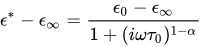
In this equation ϵ∗{displaystyle epsilon ^{*}}


It is worth emphasizing that the Cole–Cole model is an empirical model of the measured data. It has been successfully applied to a wide variety of tissues over the past 60 years, but it does not give any information about the underlying causes of the phenomena being measured.
Several references in the literature use a form of the Cole equation written in terms of impedance instead of a complex permittivity.[7] The impedance Z{displaystyle Z}
Z=R∞+R0−R∞1+(jffc)1−α{displaystyle Z=R_{infty }+{frac {R_{0}-R_{infty }}{1+({tfrac {jf}{f_{c}}})^{1-alpha }}}}
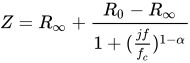
Where R0{displaystyle R_{0}}


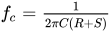
A simple interpretation of the above equation is in terms of a circuit where a resistance S{displaystyle S}


References[edit]
^ Goldman, D.E. 1985. Kenneth S. Cole 1900-1984. Biophysical Journal 47:859-860
^ ab "Kenneth Cole, 83, Scientist, is Dead". New York Times. April 20, 1984.Kenneth S. Cole, winner of the National Medal of Science and a pioneer in the study of the electrical properties of nerves and other living cells, died Wednesday at the Wesley Palms Retirement Home in La Jolla, California He was 83 years old. Dr. Cole, known as the father of biophysics, was one of the first scientists to apply the concepts and techniques of physics to the study of the excitation and response of living cells. His studies of electrical resistance in nerve cells, especially those of squid, laid the foundation for the rapid advance of neurophysiology in the 1930s and 1940s.
.mw-parser-output cite.citation{font-style:inherit}.mw-parser-output q{quotes:"""""""'""'"}.mw-parser-output code.cs1-code{color:inherit;background:inherit;border:inherit;padding:inherit}.mw-parser-output .cs1-lock-free a{background:url("//upload.wikimedia.org/wikipedia/commons/thumb/6/65/Lock-green.svg/9px-Lock-green.svg.png")no-repeat;background-position:right .1em center}.mw-parser-output .cs1-lock-limited a,.mw-parser-output .cs1-lock-registration a{background:url("//upload.wikimedia.org/wikipedia/commons/thumb/d/d6/Lock-gray-alt-2.svg/9px-Lock-gray-alt-2.svg.png")no-repeat;background-position:right .1em center}.mw-parser-output .cs1-lock-subscription a{background:url("//upload.wikimedia.org/wikipedia/commons/thumb/a/aa/Lock-red-alt-2.svg/9px-Lock-red-alt-2.svg.png")no-repeat;background-position:right .1em center}.mw-parser-output .cs1-subscription,.mw-parser-output .cs1-registration{color:#555}.mw-parser-output .cs1-subscription span,.mw-parser-output .cs1-registration span{border-bottom:1px dotted;cursor:help}.mw-parser-output .cs1-hidden-error{display:none;font-size:100%}.mw-parser-output .cs1-visible-error{font-size:100%}.mw-parser-output .cs1-subscription,.mw-parser-output .cs1-registration,.mw-parser-output .cs1-format{font-size:95%}.mw-parser-output .cs1-kern-left,.mw-parser-output .cs1-kern-wl-left{padding-left:0.2em}.mw-parser-output .cs1-kern-right,.mw-parser-output .cs1-kern-wl-right{padding-right:0.2em}
^ Schwan HP. 2001. The concept of bioimpedance from the start: evolution and personal historical reminiscences. Proc. IX Bioimpedance Conf., Oslo, Norway
^ ab Huxley, Andrew. "Kenneth Stewart Cole". Retrieved 2007-06-14.
^ "Kenneth S. Cole". National Academy of Sciences. Retrieved September 18, 2016.
^ "Book of Members, 1780–2010: Chapter C" (PDF). American Academy of Arts and Sciences. Retrieved September 18, 2016.
^ Brown, B H; Smallwood, R H; Barber, D C; Lawford, P V; Hose, D R (1999). Medical Physics And Biomedical Engineering. Turtleback Books. p. 736. ISBN 9780613919692.
Publications[edit]
- Cole, K.S. 1979. Mostly membranes. Annual Review of Physiology 41:1-23
PMID 373584
- Cole, K. S., and R. H. Cole. 1941. Dispersion and absorption in dielectrics. J. Chem. Phys. 9:341-351 [1]
- Cole, K.S., and Baker, R.F. 1941. Longitudial Impedance of the Squid Giant Axon. J. Gen. Physiol. 24:771-788 (Inductance of membrane)
External links[edit]
- National Academy of Sciences Biographical Memoir
Authority control  |
|
|---|
Categories:
- 1900 births
- 1984 deaths
- American biophysicists
- American physicists
- Columbia University staff
- Cornell University alumni
- Fellows of the American Academy of Arts and Sciences
- Foreign Members of the Royal Society
- Guggenheim Fellows
- Manhattan Project people
- Members of the United States National Academy of Sciences
- National Medal of Science laureates
- Oberlin College alumni
- Scientists from Ithaca, New York
- Scripps Institution of Oceanography faculty


(window.RLQ=window.RLQ||).push(function(){mw.config.set({"wgPageParseReport":{"limitreport":{"cputime":"0.528","walltime":"0.705","ppvisitednodes":{"value":2511,"limit":1000000},"ppgeneratednodes":{"value":0,"limit":1500000},"postexpandincludesize":{"value":154402,"limit":2097152},"templateargumentsize":{"value":1905,"limit":2097152},"expansiondepth":{"value":18,"limit":40},"expensivefunctioncount":{"value":7,"limit":500},"unstrip-depth":{"value":1,"limit":20},"unstrip-size":{"value":16473,"limit":5000000},"entityaccesscount":{"value":1,"limit":400},"timingprofile":["100.00% 458.836 1 -total"," 42.38% 194.466 1 Template:Infobox_scientist"," 39.70% 182.136 1 Template:Infobox_person"," 34.68% 159.105 2 Template:Infobox"," 25.67% 117.771 1 Template:Reflist"," 17.53% 80.421 1 Template:Cite_news"," 13.08% 60.009 5 Template:Br_separated_entries"," 12.10% 55.499 1 Template:Winners_of_the_National_Medal_of_Science"," 11.94% 54.779 1 Template:Authority_control"," 10.79% 49.525 1 Template:Navbox_with_collapsible_groups"]},"scribunto":{"limitreport-timeusage":{"value":"0.198","limit":"10.000"},"limitreport-memusage":{"value":3960332,"limit":52428800}},"cachereport":{"origin":"mw1319","timestamp":"20181127202304","ttl":86400,"transientcontent":true}}});});{"@context":"https://schema.org","@type":"Article","name":"Kenneth Stewart Cole","url":"https://en.wikipedia.org/wiki/Kenneth_Stewart_Cole","sameAs":"http://www.wikidata.org/entity/Q1738910","mainEntity":"http://www.wikidata.org/entity/Q1738910","author":{"@type":"Organization","name":"Contributors to Wikimedia projects"},"publisher":{"@type":"Organization","name":"Wikimedia Foundation, Inc.","logo":{"@type":"ImageObject","url":"https://www.wikimedia.org/static/images/wmf-hor-googpub.png"}},"datePublished":"2007-01-08T01:51:28Z","dateModified":"2018-09-11T04:40:49Z","image":"https://upload.wikimedia.org/wikipedia/en/6/69/Kenneth_Stewart_Cole.gif","headline":"American biophysicist"}(window.RLQ=window.RLQ||).push(function(){mw.config.set({"wgBackendResponseTime":105,"wgHostname":"mw1246"});});


