Phosphorylase
Phosphorylase
Jump to navigation
Jump to search
| Phosphorylase | |||||||||
|---|---|---|---|---|---|---|---|---|---|
 | |||||||||
| Identifiers | |||||||||
| EC number | 2.4.1.1 | ||||||||
| CAS number | 9035-74-9 | ||||||||
| Databases | |||||||||
| IntEnz | IntEnz view | ||||||||
| BRENDA | BRENDA entry | ||||||||
| ExPASy | NiceZyme view | ||||||||
| KEGG | KEGG entry | ||||||||
| MetaCyc | metabolic pathway | ||||||||
| PRIAM | profile | ||||||||
PDB structures | RCSB PDB PDBe PDBsum | ||||||||
| |||||||||
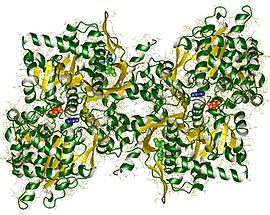
Phosphorylases are enzymes that catalyze the addition of a phosphate group from an inorganic phosphate (phosphate+hydrogen) to an acceptor.
- A-B + P ⇌ A + P-B
They include allosteric enzymes that catalyze the production of glucose-1-phosphate from a glucan such as glycogen, starch or maltodextrin. Phosphorylase is also a common name used for glycogen phosphorylase in honor of Earl W. Sutherland Jr. who in the late 1930s discovered the first phosphorylase.[1]
Contents
1 Function
2 Types
3 Activation
4 Pathology
5 See also
6 References
7 External links
Function[edit]
Phosphorylases should not be confused with phosphatases, which remove phosphate groups.
In more general terms, phosphorylases are enzymes that catalyze the addition of a phosphate group from an inorganic phosphate (phosphate + hydrogen) to an acceptor, not to be confused with a phosphatase (a hydrolase) or a kinase (a phosphotransferase). A phosphatase removes a phosphate group from a donor using water, whereas a kinase transfers a phosphate group from a donor (usually ATP) to an acceptor.
| Enzyme name | Enzymes class | Reaction | Notes |
|---|---|---|---|
| Phosphorylase | Transferase (EC 2.4 and EC 2.7.7) | A-B + H-OP ⇌ A-OP + H-B | transfer group = A = glycosyl- group or nucleotidyl- group |
| Phosphatase | Hydrolase (EC 3) | P-B + H-OH ⇌ P-OH + H-B | |
| Kinase | Transferase (EC 2.7.1-2.7.4) | P-B + H-A ⇌ P-A + H-B | transfer group = P |
P = phosphonate group, OP = phosphate group, H-OP or P-OH = inorganic phosphate | |||
Types[edit]
The phosphorylases fall into the following categories:
- Glycosyltransferases (EC 2.4)
- Enzymes that break down glucans by removing a glucose residue (break O-glycosidic bond)
- glycogen phosphorylase
- starch phosphorylase
- maltodextrin phosphorylase
- Enzymes that break down nucleosides into their constituent bases and sugars (break N-glycosidic bond)
Purine nucleoside phosphorylase (PNPase)
- Enzymes that break down glucans by removing a glucose residue (break O-glycosidic bond)
- Nucleotidyltransferases (EC 2.7.7)
- Enzymes that have phosphorolytic 3' to 5' exoribonuclease activity (break phosphodiester bond)
- RNase PH
Polynucleotide Phosphorylase (PNPase)
- Enzymes that have phosphorolytic 3' to 5' exoribonuclease activity (break phosphodiester bond)
All known phosphorylases share catalytic and structural properties [1].
Activation[edit]
Phosphorylase a is the more active R form of glycogen phosphorylase that is derived from the phosphorylation of the less active R form, phosphorylase b with associated AMP. The inactive T form is either posphorylated by phosphoylase kinase and inhibited by glucose, or dephosphorylated by phosphoprotein phosphatase with inhibition by ATP and/or glucose 6-phosphate. Phosphorylation requires ATP but dephosphorylation releases free inorganic phosphate ions.
Pathology[edit]
Some disorders are related to phosphorylases:
Glycogen storage disease type V - muscle glycogen
Glycogen storage disease type VI - liver glycogen
See also[edit]
- Hydrolase
References[edit]
^ Lehninger Principles of Biochemistry 5th ed. pg. 603
External links[edit]
- Muscle phosphorylase deficiency - McArdle's Disease Website
Phosphorylases at the US National Library of Medicine Medical Subject Headings (MeSH)

This EC 2.4 enzyme-related article is a stub. You can help Wikipedia by expanding it. |
Categories:
- Transferases
- EC 2.4.1


(window.RLQ=window.RLQ||).push(function(){mw.config.set({"wgPageParseReport":{"limitreport":{"cputime":"0.264","walltime":"0.325","ppvisitednodes":{"value":849,"limit":1000000},"ppgeneratednodes":{"value":0,"limit":1500000},"postexpandincludesize":{"value":121723,"limit":2097152},"templateargumentsize":{"value":908,"limit":2097152},"expansiondepth":{"value":10,"limit":40},"expensivefunctioncount":{"value":0,"limit":500},"unstrip-depth":{"value":0,"limit":20},"unstrip-size":{"value":339,"limit":5000000},"entityaccesscount":{"value":0,"limit":400},"timingprofile":["100.00% 178.515 1 -total"," 49.11% 87.669 11 Template:Navbox"," 46.17% 82.427 2 Template:Infobox"," 39.10% 69.796 1 Template:Infobox_enzyme"," 22.03% 39.335 1 Template:Kinases"," 10.81% 19.289 1 Template:Portal_bar"," 10.77% 19.233 1 Template:Glycosyltransferases"," 6.89% 12.305 1 Template:2.4-enzyme-stub"," 5.89% 10.519 1 Template:Asbox"," 3.76% 6.713 1 Template:Enzymes"]},"scribunto":{"limitreport-timeusage":{"value":"0.088","limit":"10.000"},"limitreport-memusage":{"value":1899909,"limit":52428800}},"cachereport":{"origin":"mw1248","timestamp":"20181023205841","ttl":1900800,"transientcontent":false}}});mw.config.set({"wgBackendResponseTime":443,"wgHostname":"mw1248"});});

 Clash Royale CLAN TAG

