• transferase activity • metal ion binding • galactosylgalactosylxylosylprotein 3-beta-glucuronosyltransferase activity
Cellular component
• integral component of membrane • Golgi apparatus • membrane • Golgi membrane
Biological process
• glycosaminoglycan metabolic process • protein glycosylation • chondroitin sulfate proteoglycan biosynthetic process • chondroitin sulfate metabolic process • carbohydrate metabolic process
Sources:Amigo / QuickGO
Orthologs
Species
Human
Mouse
Entrez
135152
280645
Ensembl
ENSG00000112309
ENSMUSG00000026156
UniProt
Q9NPZ5
P59270
RefSeq (mRNA)
NM_080742
NM_172124
RefSeq (protein)
NP_542780
NP_742122
Location (UCSC)
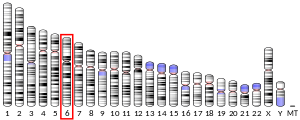
Chr 6: 70.86 – 70.96 Mb
Chr 1: 23.76 – 23.85 Mb
PubMed search
[3]
[4]
Wikidata
View/Edit Human
View/Edit Mouse
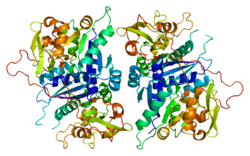
Galactosylgalactosylxylosylprotein 3-beta-glucuronosyltransferase 2 is an enzyme that in humans is encoded by the B3GAT2 gene.[5][6]
The product of this gene is a transmembrane protein belonging to the glucuronyltransferase family, and catalyzes the transfer of a beta-1,3 linked glucuronic acid to a terminal galactose in different glycoproteins or glycolipids containing a Gal-beta-1-4GlcNAc or Gal-beta-1-3GlcNAc residue. The encoded protein is involved in the synthesis of the human natural killer-1 (HNK-1) carbohydrate epitope, a sulfated trisaccharide implicated in cellular migration and adhesion in the nervous system.[6]
Contents
1Use of HNK-1 Antibody for Neural Crest Research
2References
3External links
4Further reading
Use of HNK-1 Antibody for Neural Crest Research[edit]
Antibodies raised against the HNK-1 epitope have played a large role in studies of the neural crest, especially in the avian embryo.[7] The first antibody raised against this epitope was NC-1,[8] which permitted much easier analyses of neural crest migration pathways. In avians, and especially in other vertebrates, the results of HNK-1 staining should be interpreted with caution as the epitope is not unique to the neural crest.
References[edit]
^ abcGRCh38: Ensembl release 89: ENSG00000112309 - Ensembl, May 2017
^ abcGRCm38: Ensembl release 89: ENSMUSG00000026156 - Ensembl, May 2017
^Imiya K, Ishizaki T, Seiki T, Saito F, Inazawa J, Oka S, Kawasaki T (Oct 2002). "cDNA cloning, genomic structure and chromosomal mapping of the mouse glucuronyltransferase-S involved in the biosynthesis of the HNK-1 carbohydrate epitope". Gene. 296 (1–2): 29–36. doi:10.1016/S0378-1119(02)00840-5. PMID 12383500.
^Bronner-Fraser M (May 1986). "Analysis of the early stages of trunk neural crest migration in avian embryos using monoclonal antibody HNK-1". Dev. Biol. 115 (1): 44–55. doi:10.1016/0012-1606(86)90226-5. PMID 3516760.
^Vincent M, Thiery JP (June 1984). "A cell surface marker for neural crest and placodal cells: further evolution in peripheral and central nervous system". Dev. Biol. 103 (2): 468–81. doi:10.1016/0012-1606(84)90334-8. PMID 6202575.
External links[edit]
Human B3GAT2 genome location and B3GAT2 gene details page in the UCSC Genome Browser.
Nagase T, Kikuno R, Ohara O (2002). "Prediction of the coding sequences of unidentified human genes. XXII. The complete sequences of 50 new cDNA clones which code for large proteins". DNA Res. 8 (6): 319–27. doi:10.1093/dnares/8.6.319. PMID 11853319.
Strausberg RL, Feingold EA, Grouse LH, et al. (2003). "Generation and initial analysis of more than 15,000 full-length human and mouse cDNA sequences". Proc. Natl. Acad. Sci. U.S.A. 99 (26): 16899–903. doi:10.1073/pnas.242603899. PMC 139241. PMID 12477932.
Marcos I, Galán JJ, Borrego S, Antiñolo G (2003). "Cloning, characterization, and chromosome mapping of the human GlcAT-S gene". J. Hum. Genet. 47 (12): 677–80. doi:10.1007/s100380200103. PMID 12522689.
Mungall AJ, Palmer SA, Sims SK, et al. (2003). "The DNA sequence and analysis of human chromosome 6". Nature. 425 (6960): 805–11. doi:10.1038/nature02055. PMID 14574404.
Ota T, Suzuki Y, Nishikawa T, et al. (2004). "Complete sequencing and characterization of 21,243 full-length human cDNAs". Nat. Genet. 36 (1): 40–5. doi:10.1038/ng1285. PMID 14702039.
Kakuda S, Oka S, Kawasaki T (2004). "Purification and characterization of two recombinant human glucuronyltransferases involved in the biosynthesis of HNK-1 carbohydrate in Escherichia coli". Protein Expr. Purif. 35 (1): 111–9. doi:10.1016/j.pep.2003.12.021. PMID 15039073.
Kakuda S, Sato Y, Tonoyama Y, et al. (2005). "Different acceptor specificities of two glucuronyltransferases involved in the biosynthesis of HNK-1 carbohydrate". Glycobiology. 15 (2): 203–10. doi:10.1093/glycob/cwi001. PMID 15470230.
Kimura K, Wakamatsu A, Suzuki Y, et al. (2006). "Diversification of transcriptional modulation: large-scale identification and characterization of putative alternative promoters of human genes". Genome Res. 16 (1): 55–65. doi:10.1101/gr.4039406. PMC 1356129. PMID 16344560.
Shiba T, Kakuda S, Ishiguro M, et al. (2006). "Crystal structure of GlcAT-S, a human glucuronyltransferase, involved in the biosynthesis of the HNK-1 carbohydrate epitope". Proteins. 65 (2): 499–508. doi:10.1002/prot.21118. PMID 16897771.
v
t
e
PDB gallery
@media all and (max-width:720px){.mw-parser-output .mw-module-gallery{display:block!important;float:none!important}.mw-parser-output .mw-module-gallery div{display:inherit!important;float:none!important;width:auto!important}}
0
Multi page form doesn't track abandonment properly when page reloads Hi I have been using the GTM technique detailed by Simo Ahava to track form abandonment and the event is being returned to GA but not correctly. The 3rd party form I am tracking is multipage and you click submit input buttons to move to each new page. This submit button is triggering the form abandonment event even though I am on the same form and have not finished it yet. The form action points to the page itself and so the page url never changes, even on the thank you page. How can configure GTM to ignore these submissions/ reloads and only fire the abandonment when the browser window is closed? https://www.simoahava.com/analytics/track-form-abandonment-with-google-tag-manager/ simo #abandonment #fromtracking¢
...
Help:Taxon identifiers From Wikipedia, the free encyclopedia Jump to navigation Jump to search For help with the Wikipedia template, see Template:Taxonbar. This is an information page. It describes the editing community's established practice on some aspect or aspects of Wikipedia's norms and customs. It is not one of Wikipedia's policies or guidelines, as it has not been thoroughly vetted by the community. .mw-parser-output .module-shortcutboxplain{float:right;border:1px solid #aaa;background:#fff;margin:0 0 0 1em;padding:.3em .6em .2em .6em;text-align:center;font-size:85%;font-weight:bold}.mw-parser-output .module-shortcutlist{display:inline-block;border-bottom:1px solid #aaa;margin-bottom:.2em;font-weight:normal}.mw-parser-output .module-shortcutanchordiv{position:relative;top:-3em} Shortcut H:TI Readers' FAQ and help About Wikipedia Administration FAQs Authority control Cat...






 Clash Royale CLAN TAG

